

How Do You Choose the Right Amber Glass Jar?
Key Takeaways
- Amber glass jars filter out much of the UV and blue light that can spoil light-sensitive products, while still letting customers see roughly what's inside.
- They suit creams, balms, butters, herbs, teas, supplements, powders and candles, where light protection or an apothecary look matters.
- Shape matters as much as colour. Squat jars are for scooping, while taller, narrower-necked jars suit powders, capsules and dry goods.
- Choose the jar and lid together, and use the Add Compatible Item section on each product page to find a closure that fits.
- Browse our cosmetic jars and medical jars, or get in touch and we'll help you choose.
Why Do So Many Brands Choose Amber Glass Jars?
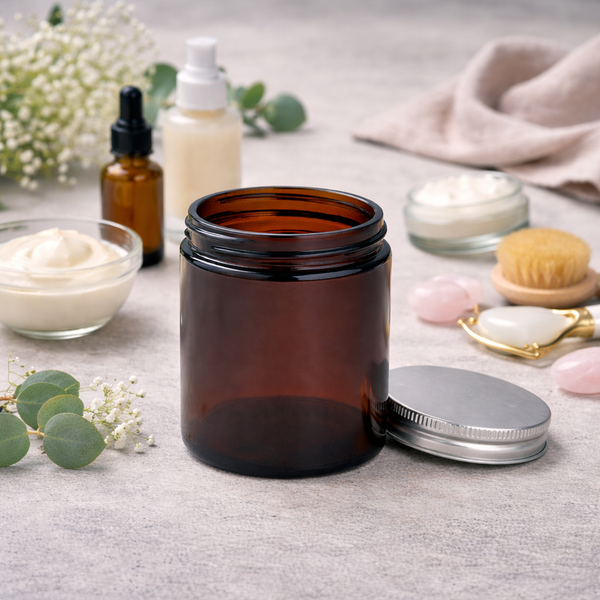
Amber jars are a go-to for creams, balms and natural skincare.
Walk into any natural skincare shop, apothecary or herbalist and you'll see them everywhere.
Brown glass jars. Plain, sturdy and instantly recognisable.
That's not an accident.
Amber glass has been used for light-sensitive products for a very long time. The colour does a job. It reduces the amount of ultraviolet and blue light that reaches whatever's inside, which helps protect many oils, botanical extracts and active ingredients from breaking down as quickly.
It also looks the part. Amber says "natural", "handmade" and "apothecary" before a customer has read a word of your label.
And it's glass, so it doesn't react with most products, it's easy to clean and it can be recycled.
Put those together and you can see why amber jars have become a default for so many small brands.
How Does Amber Glass Protect What's Inside?
Light carries energy. Some ingredients react to it.
Over time, exposure to sunlight or bright shop lighting can change the colour, scent or effectiveness of light-sensitive formulas. Natural oils can go rancid faster. Botanical extracts can fade. Some vitamins and actives become less stable.
Clear glass lets almost all of that light straight through.
Amber glass filters out a large share of the UV and blue end of the spectrum. It doesn't make a product last forever, and it isn't a substitute for a good formula, sensible preservatives or proper storage. But it does give light-sensitive contents a much better chance than clear glass.
If you want the full comparison, our guide to amber vs clear glass goes into more detail.
What Products Suit Amber Glass Jars?

Featured product
A wide, easy-to-scoop jar for body butters, balms, scrubs and candles.
View productMore than you might think.
Skincare and cosmetics
Face creams, body butters, balms, salves, masks and scrubs are the classic use. Many contain plant oils and extracts that benefit from protection from light, and a wide amber jar makes them easy to scoop from.
Herbs, teas and spices
Dried herbs and loose teas lose colour and aroma when they sit in bright light. An amber jar with a well-fitting lid keeps out light, air and moisture far better than a paper bag. There's more on this in our guide to protecting herbs with the right storage jar.
Supplements, powders and capsules
Powders, capsules and tablets are often packed in taller amber jars with narrower necks. They're easy to pour from, and the darker glass helps protect ingredients that don't like light.
Candles and home fragrance
Amber jars give candles a warm, apothecary look that works well in autumn and winter ranges. If you're making candles, use glass that's sold as suitable for candle making, and always test burn your finished candle in the jar you plan to sell it in.
What Shape of Amber Jar Should You Choose?

Squat jars come in a range of sizes. Sample a few side by side.
Colour is only half the decision. The shape of the jar decides how your customer uses the product.
Squat jars are short and wide. They're the natural choice for anything you scoop with fingers or a spatula: creams, balms, butters and scrubs. They're also easy to fill and easy to clean.
Powder jars are taller with a narrower neck. That makes them better for things you pour or shake out, like capsules, tablets, powders and loose herbs.
Apothecary-style jars are more about display. Think bath salts, tea blends or products for gift sets.
The simple test: how will someone get the product out? Start there and the shape usually chooses itself.
What Size Amber Jar Do You Need?

Featured product
A taller jar for capsules, powders and dried herbs that you pour rather than scoop.
View productWork backwards from how much your customer uses and how quickly.
A rich face cream used a little at a time suits a small jar, around 30ml to 60ml. Body butters and balms usually sit in the middle, often 120ml to 180ml. Bath salts, scrubs and bulk herbs need more room, so 500ml jars come into play.
There's another reason to think small.
Every time a jar is opened, the product meets air, light and fingers. A smaller jar that's used up sooner can help keep the contents fresher.
Don't forget headspace, either. Leave a sensible gap between the product and the lid, especially if you fill warm.
If you're torn between two sizes, sample both. Fill them with your actual product, label them and put them side by side.
That's usually all it takes.
Which Lid Should You Put on an Amber Glass Jar?

The same jar can look very different with a black, silver, copper or gold lid.
The jar and lid are a pair. Choose them together.
Amber jars are commonly paired with black plastic screw caps, silver aluminium lids or metallic finishes. A black cap looks clean and clinical. Aluminium feels natural and slightly apothecary. Gold or copper lifts the jar into gift territory.
What matters most is fit.
Each jar has a neck finish, which is the size and thread of the opening. A lid made for a different finish might go on, but it may not seal properly, may loosen in the post or may cross-thread when a customer closes it.
That's why every product page on our site has an Add Compatible Item section. It only shows closures that fit the jar you're looking at, and the image updates so you can see the combination. For a wider overview, see our Closures & Components Guide.
Also check the lid's liner. Oils, fragrances and acids can react differently with different liners, so test with your real product.
Is Amber Glass Always the Best Choice?

Amber protects. Clear shows off the product. Pick the one your formula needs.
Not always.
Clear glass is better when the product sells itself. Colourful bath salts, layered scrubs and whipped butters often look best when customers can see them. If your formula isn't sensitive to light, clear glass is a perfectly good choice.
Amber glass is the practical middle ground. Good light protection, a natural look and a wide choice of shapes and sizes.
Miron violet glass goes further. It's designed to block most visible light while letting through selected parts of the spectrum, and it's popular with premium skincare, herbal and oil brands that want the highest level of protection. You can read more about it on our violet glass page.
So the question isn't "is amber the best?" It's "what does my product need, and what does my customer expect to see?"
What Are the Most Common Mistakes With Amber Jars?

Featured product
A step up from amber for premium creams and balms that need extra protection from light.
View productWe see a few again and again.
- Treating amber as a preservative. It reduces light exposure. It doesn't stop bacteria, air or heat.
- Buying the lid separately without checking the fit. Nearly right is still wrong.
- Choosing a jar that's too big. Large jars that take months to use up expose the product to air every time they're opened.
- Not testing the label. Amber is darker than clear glass, so check your artwork and text are easy to read against it.
- Skipping samples. A few test jars filled with your real product will tell you more than any spec sheet.
The Bottom Line
Amber glass jars are popular for a reason.
They help protect light-sensitive products, they look natural and trustworthy, and they come in shapes and sizes for almost anything, from face creams to capsules.
Start with your product. Choose the shape that matches how it's used, a size that gets used up while it's fresh, and a lid that fits properly. If you need even more protection, look at Miron violet glass.
Then test before you scale up.
You can browse all our jars, or contact us and tell us what you're making. We'll help you find the right jar.
FAQs
Why are amber glass jars brown?
Amber glass is coloured during manufacture. The brown tint is what filters out much of the UV and blue light that can affect light-sensitive products.
Do amber glass jars block all UV light?
No glass blocks every bit of light. Amber filters out a large share of UV and blue light, which gives much better protection than clear glass, but it's still best to store products away from direct sunlight.
Are amber glass jars good for skincare?
Yes. They're widely used for creams, balms and butters, especially natural formulas that contain plant oils and extracts. Wide squat jars make scooping easy.
Can you put candles in amber glass jars?
Many candle makers do. Use glass that's sold as suitable for candle making and test burn your finished candle in that jar before you sell it.
Is Miron violet glass better than amber?
Miron violet glass is designed to give a higher level of light protection than amber. It's a good choice for premium or very light-sensitive products. Amber is a practical, widely used option for most others.
How do I find a lid that fits my amber jar?
Open the jar's product page and look for the Add Compatible Item section. It lists closures that fit that jar and shows you the combination before you order.
Laissez un commentaire